
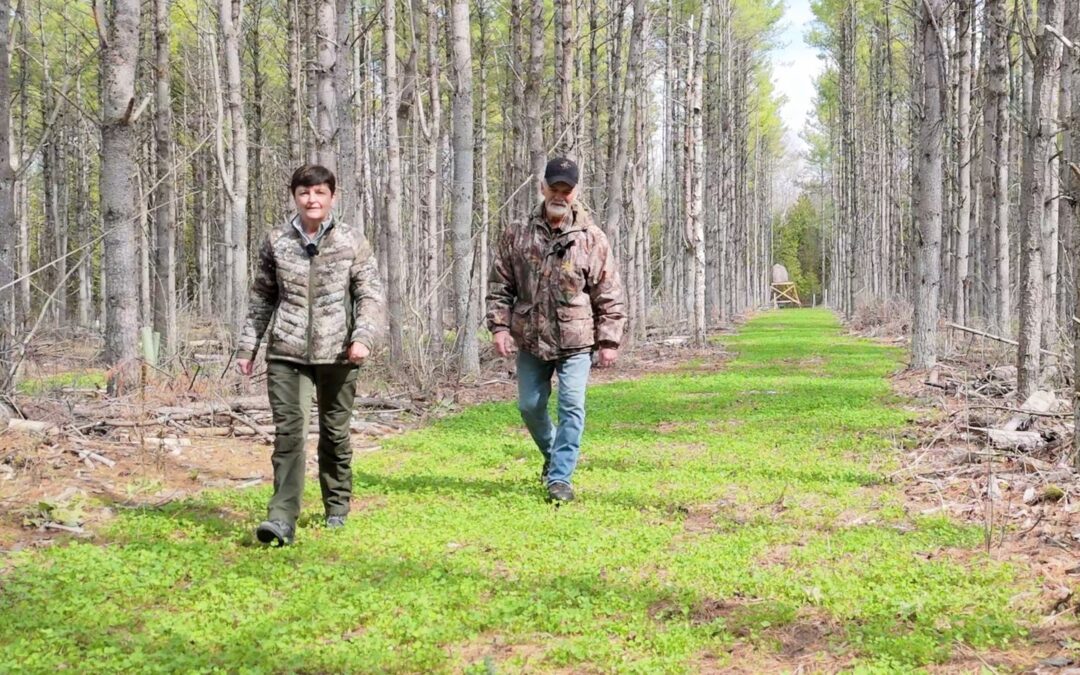
For more than four decades, Rose has been a careful student of her 75-acre property in rural Ontario. She knows which plots green up fastest in spring. She knows where the deer bed at dusk, and which food plots they visit before first light. She knows that the morel mushrooms that appeared in clusters along the newly opened lanes last year were not an accident. They were evidence.
“It speeds up the decomposition process and thereby improves the soil quicker,” she explains, standing in one of the laneways that now cuts cleanly through what was, not long ago, an almost impenetrable tangle of brush. “Which helps the other vegetation to grow better.”
The story of this property is, in many ways, a story about time. Rose and her late husband acquired the land from the Ontario Ministry of Natural Resources in 1979. Twenty-five of those acres had been planted in the 1960s as a pine plantation, trees set every six feet in dense rows, never thinned, never managed. “It was basically a biological desert,” Rose says. “The trees were not healthy, there wasn’t enough growth on them, and there was nothing there for the wildlife to eat or for bedding habitat.”
For years, the only option was to drive around the perimeter. You could not walk through it.
A Logger’s Promise
When Rose decided to act a few short years ago, she and her husband Bob brought in a licensed forestry cutter to thin the plantation. He was professional, and by most accounts, he did a reasonable job of what loggers do: he extracted the timber of value and moved on. What he left behind was a landscape of treetops, branch debris, and slash piled so thick that traversing it, even on foot, was all but impossible.
He assured her it would be gone in two years.
“That’s nonsense,” Rose says now, matter-of-factly. “No.” More than five years later, the slash remained essentially intact, exactly where the logger had left it, slowly smothering any chance of regeneration beneath. She and Bob still have a small reference area that retains the features of the original attempt to restore balance to the land. As they gaze at the mess, it’s clear that there are some regrets.
Kyle Hokkanen, owner of Green Acres Forestry and Landscaping, has seen this situation many times. “Loggers,” he sighs. “They come in and they extract anything of value, and they get out of there, and they don’t usually care what it looks like when they leave,” he says. “There’s a lot of sugar coating. They tell people what they want to hear so they get permission to come in and get the valuable timber out.”
When Kyle first visited the property, his assessment was direct. “They kind of left you in a pickle here.”
Not Loggers. Something Different.
What Green Acres brought to the property was forestry mulching, but the word alone undersells what that means in practice. Kyle is careful to draw a clear line between what his company does and what a logger, or even an under-equipped mulching service, leaves behind.
“There’s mulching and there’s mulching,” he says. With the wrong machine or insufficient power, the material is knocked down but left in four-foot chunks, still tripping hazards, still barely decomposing. “Our finished product is seed ready.”
The distinction matters ecologically as well as practically. Rather than piling debris and burning it, which removes nutrients from the soil and contributes to landfill pressure, Green Acres grinds everything down to thumbnail-sized chips and spreads it over the ground. “We’ve sped up the decomposition process so much by integrating this mulch into the soil,” Kyle explains. “The proof is in the pudding out there. We’ve got inches and inches of black earth now, where before there was sand and pine needles. That was it.”
Rose had watched that transformation with her own eyes. “It used to be just sand,” she says. “You can see now that it’s got some organic matter. And that’ll just improve over time.”
A Property Reclaimed
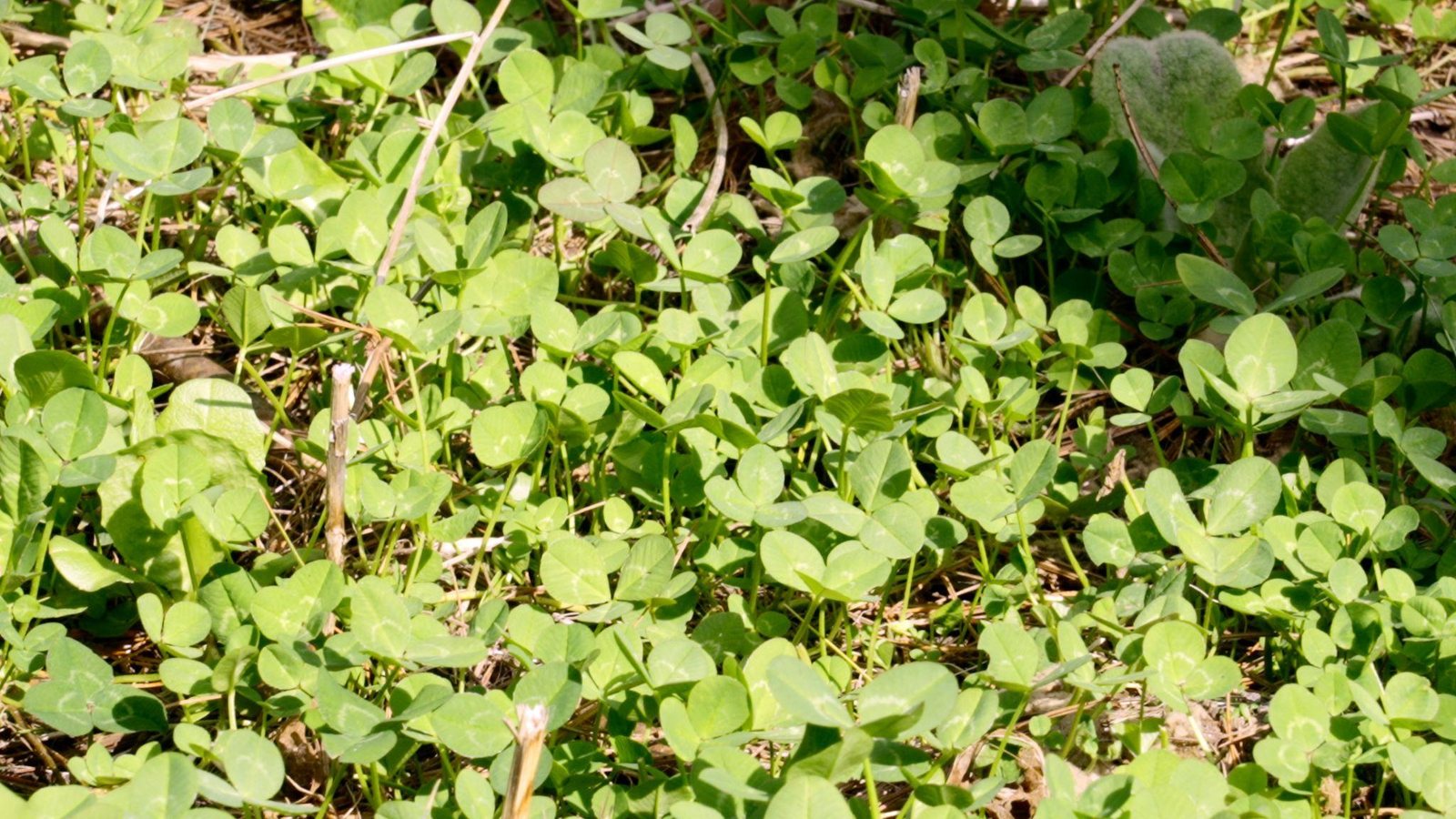
Clover and chicory in the managed food plots — where there was sand and pine needles.
The results, visible now in every direction from the cleared laneways, are striking. Where 25 acres were effectively unusable, food plots of clover and chicory now grow in managed rows. In an adjacent field cereal rye planted in the fall pushes through the soil thick enough that Rose mows it back to keep it productive. White-tailed deer, turkeys, rabbits, partridge, and a remarkable variety of birds have thrived in the now-integrated forest and field ecosystem. Trail cameras capture bucks in summer velvet and does fat and well-fed heading into winter.
Bob, reflecting on the scope of the change, puts it simply. “It was basically a wasteland. Now it’s useful.”
But for Rose, the vision extends well beyond the present season. She and Bob have planted sweet chestnuts, sawtooth oaks, white oaks, and apple trees, species chosen specifically for their value as long-term wildlife food sources. “Hopefully in my lifetime, I’ll see some of those trees,” she says. Bob, who will turn 77 in July, is clear-eyed about the longer arc. “I may never see the chestnuts out of them. But somebody will in the future. We do our part to help benefit the environment.”
“The thinning and mulching allows you to enjoy your whole property more,” Rose says, “even if it’s not for hunting, even if it’s for just a family walking the woods, even if your kids want to ride their dirt bikes around the woods. It’s trails. It’s access. It enables you to enjoy your property.”
Kyle, who walked the property alongside them on a cool spring morning, is still taking in what he saw. “I’ve not visited a place that’s been so well managed like this,” he says. “It’s gorgeous. It’s like a natural park.”
From the perimeter of a pine wasteland to a place people want to linger. That is the transformation Green Acres came to help with, and the one Rose and Bob brought to life.
Rose and Bob’s property — forestry mulching and the soil that came back.
Wondering what your own land could become? We’ll walk it with you and tell you straight.